


What does Jesus last command to us mean now?
All authority in heaven and on earth has been given to me. Therefore, go and make disciples of all nations, baptising them in the name of the Father and of the Son and of the Holy Spirit, and teaching them to obey everything I have commanded you. And surely I am with you always, to the very end of the age.”
Matthew 28:18-20
Ulterior Motives are different to Ultimate Motives
Ulterior means something is intentionally kept concealed. An ulterior motive is usually manipulative. It’s when we do or say one thing out in the open but intend or mean another thing in private.
Ultimate means the farthest point of a journey. An ultimate goal is an eventual point or a longed-for destination. Examples are when a person begins college hoping to become a physician one day or when a kid starts playing basketball with dreams of one day playing in the NBA.
We are not Salespeople
We believe that Jesus answers the ultimate questions of life and has the ultimate answers for our cities and neighborhoods. Our hope, dream, and desire is that everyone will have a meaningful relationship with Jesus. So sharing the story of Jesus and his impact on our lives is the right motive, but it cannot be an ulterior motive in developing relationships. We don’t love our neighbors to convert them; we love our neighbors because we are converted.
— The Art of Neighboring, chapter 7
What we do matters, but God also cares about why we do it.
But the LORD said to Samuel, “Do not consider his appearance or his height, for I have rejected him. The LORD does not look at the things people look at. People look at the outward appearance, but the LORD looks at the heart.”
1 Samuel 16:7
For the appeal we make does not spring from error or impure motives, nor are we trying to trick you. On the contrary, we speak as those approved by God to be entrusted with the gospel. We are not trying to please people but God, who tests our hearts.
1 Thessalonians 2:3-4
We love because we are loved
This is love: not that we loved God, but that he loved us and sent his Son as an atoning sacrifice for our sins. Dear friends, since God so loved us, we also ought to love one another.
1 John 4:10-11
Jesus calls us to love our neighbours without making their response a condition of our love.
Jesus replied: “‘Love the Lord your God with all your heart and with all your soul and with all your mind.’ This is the first and greatest commandment. And the second is like it: ‘Love your neighbor as yourself.’ All the Law and the Prophets hang on these two commandments.
Matthew 22:37-40
Our love is meant to be a reflection of God’s grace
“You have heard that it was said, ‘Love your neighbor and hate your enemy.’ But I tell you, love your enemies and pray for those who persecute you, that you may be children of your Father in heaven. He causes his sun to rise on the evil and the good, and sends rain on the righteous and the unrighteous. If you love those who love you, what reward will you get? Are not even the tax collectors doing that? And if you greet only your own people, what are you doing more than others? Do not even pagans do that? Be perfect, therefore, as your heavenly Father is perfect.
Matthew 5:43-48
The four levels of relationship
- Context Friends– things we can both see (weather, garden, traffic etc)
- Information Friends – work, family, places lived etc
- Dreams and Desires Friends – what we hope for and what matters to us
- Regrets, Losses, and Pain Friends – the difficult experiences that have shaped us
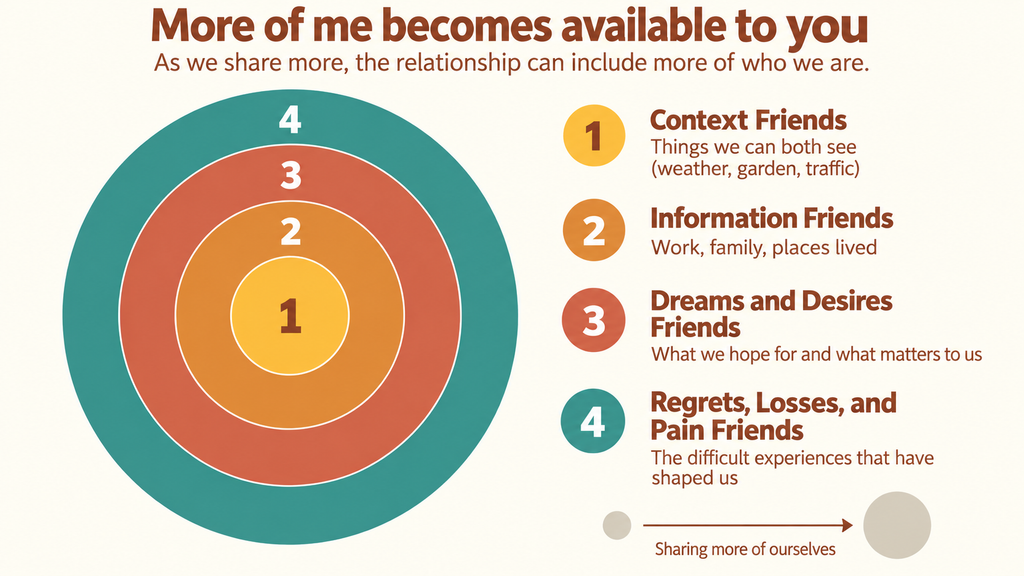
You can’t short circuit the process… Relationships grow through building bridges of shared truth
Listening, rather than talking is the best approach to loving your neighbour.
My dear brothers and sisters, take note of this: Everyone should be quick to listen, slow to speak and slow to become angry,
James 1:19
Sharing your faith is sharing YOUR faith – it speaks loudest at level four- including where we are still learning to trust Jesus
But even if you should suffer for what is right, you are blessed. “Do not fear their threats; do not be frightened.”
1 Peter 3:14-15
But in your hearts revere Christ as Lord. Always be prepared to give an answer to everyone who asks you to give the reason for the hope that you have. But do this with gentleness and respect,
People should be able to see a connection between what we say about Jesus and the way we our lives reflect HIm.
“You are the light of the world. A town built on a hill cannot be hidden. Neither do people light a lamp and put it under a bowl. Instead they put it on its stand, and it gives light to everyone in the house. In the same way, let your light shine before others, that they may see your good deeds and glorify your Father in heaven.
Matthew 5:14-16
We are responsible for being faithful with the opportunities we have. We can trust God with the growth.
I planted the seed, Apollos watered it, but God has been making it grow. So neither the one who plants nor the one who waters is anything, but only God, who makes things grow. The one who plants and the one who waters have one purpose, and they will each be rewarded according to their own labor.
1 Corinthians 3:6-8
Loving our neighbours is part of the obedience we invite others to learn.
“All authority in heaven and on earth has been given to me. Therefore, go and make disciples of all nations, baptising them in the name of the Father and of the Son and of the Holy Spirit, and teaching them to obey everything I have commanded you. And surely I am with you always, to the very end of the age.”
Matthew 28:18-20
Small Group Questions
- Read Matthew 28:18–20. Matt described how we can drift into selling Christian ideas or the benefits of faith. Where have you seen that happen, perhaps in yourself? How is helping someone know and follow Jesus different?
- Read Matthew 5:43–48. An ulterior motive is a hidden agenda; an ultimate motive is the hope that someone will come to know Jesus. How does Jesus’ teaching help us hold that hope without making our love conditional? What makes it difficult to keep loving someone who offers nothing in return or rejects what we believe?
- Think about the four levels of friendship: Context; Information; Dreams and Desires; and Regrets, Losses, and Pain. Where would you place your relationships with your neighbours? Read James 1:19. What could you do to make time, listen well and share more of yourself without rushing the relationship?
- Read 1 Peter 3:14–15. What are you learning about trusting Jesus at the moment, including through difficult experiences? Share what you feel comfortable sharing. How could you speak naturally about that hope in an everyday conversation, even with someone you are only beginning to know?
- Read Matthew 5:14–16 and 1 Corinthians 3:6–8. Think of someone in your own corner of the world. What practical step could you take this week so they experience something of God’s love? What outcome do you need to leave with God? Pray for one another and for those people.